

“`html
Think about your breakfast for a second. Bread made from wheat, coffee brewed from beans grown thousands of kilometres away, sugar, or an omelette cooked in sunflower oil. Very few of these products may have originated near your kitchen. They reach consumers through the global trade in agricultural commodities, a vast supply chain connecting farms in one continent with food markets in another.
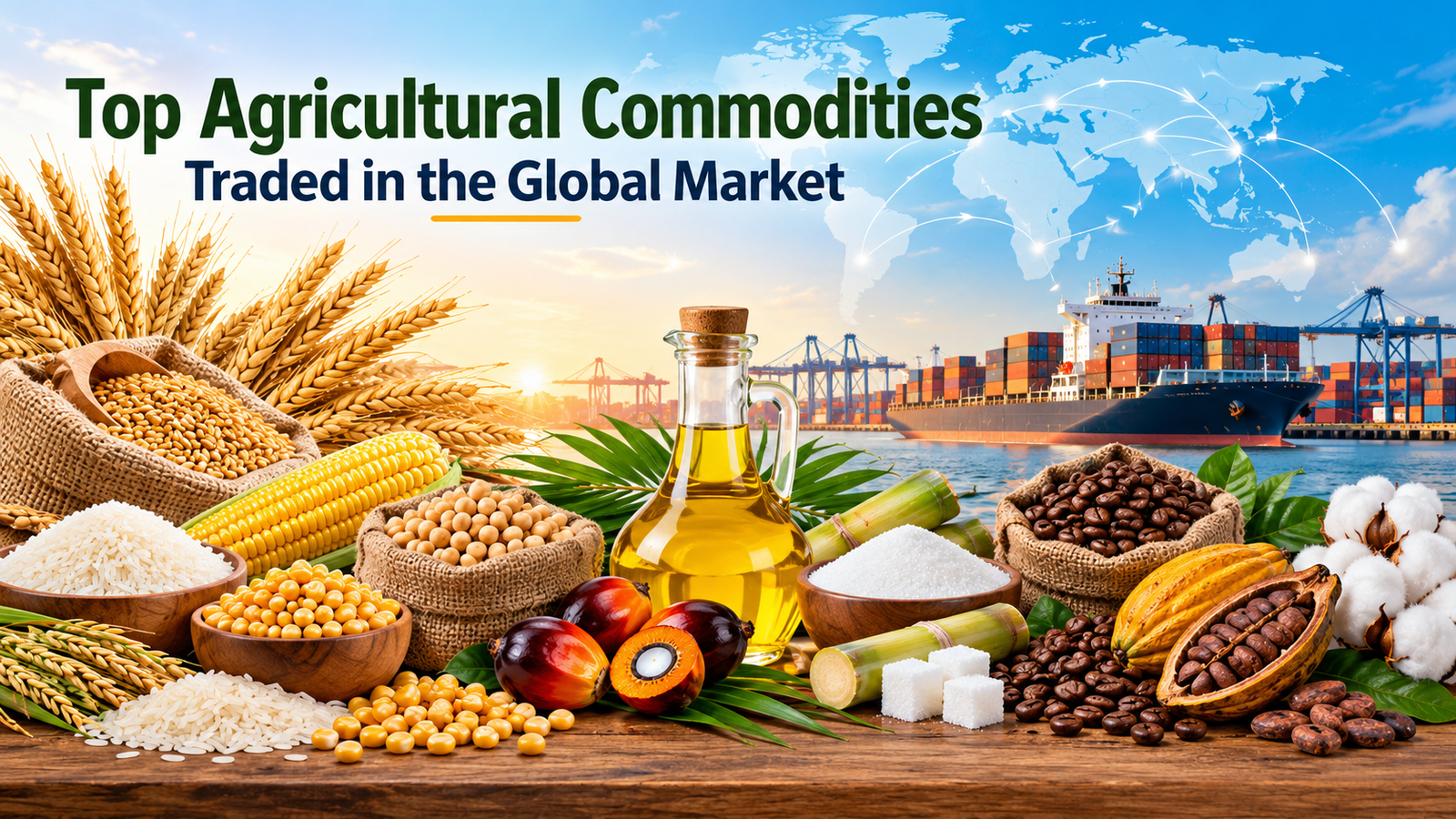
For businesses involved in food production, farming, distribution and exports, understanding the top agricultural commodities traded in the global market is essential. This guide explores the major products, leading exporting and importing countries, and the factors that influence international agricultural commodity prices.
What Are Agricultural Commodities?
Agricultural commodities are basic farm products cultivated, harvested and traded in large quantities. They are generally sold according to standard quality grades and specifications, allowing buyers and sellers to trade products without needing to identify the individual farm where each batch was produced.
These products are commonly divided into several categories:
- Grains: Wheat, rice and corn.
- Oilseeds and edible oils: Soybeans, palm oil and sunflower oil.
- Soft commodities: Sugar, coffee and cocoa.
- Agricultural fibres: Cotton and other natural fibres.
Top Agricultural Commodities Traded in the Global Market
1. Wheat – A Major Global Food Commodity
Wheat is one of the most widely traded agricultural commodities and an essential ingredient in everyday food products. It is used to manufacture bread, pasta, noodles, biscuits and various packaged foods.
Russia, the European Union, Canada, Australia and the United States are among the leading wheat exporters. Major importing markets include Egypt, Indonesia, Turkey and Algeria, where domestic production is often insufficient to meet consumption requirements.
2. Rice – An Essential Staple in International Trade
Rice is a dietary staple for billions of people, particularly across Asia. However, compared with other agricultural commodities, a relatively small proportion of global rice production enters international trade because many producing countries consume most of their domestic output.
India, Thailand, Vietnam and Pakistan are important rice-exporting countries, with India holding a leading position in international rice shipments. Because the internationally traded supply is relatively limited, changes in export policies and harvest conditions can significantly influence market prices.
3. Corn (Maize) – A Key Commodity for Food and Animal Feed
Corn, also known as maize, is an important agricultural commodity with applications across several industries. A substantial share is used for livestock feed, while the remaining production supports ethanol manufacturing, starch production, corn flour, sweeteners and cooking oil.
The United States, Brazil, Argentina and Ukraine are among the leading corn suppliers. Corn prices are also influenced by energy markets because maize is an important feedstock for ethanol production. This connection makes energy costs an important consideration for traders and agricultural businesses.
4. Soybeans – A Valuable Oilseed in Global Agriculture
Soybeans are among the most commercially important oilseeds in the international agricultural market. Processing facilities crush soybeans to produce soybean meal and soybean oil. The meal is widely used in animal feed, particularly for poultry, pigs and aquaculture, while the oil serves food and industrial applications.
Brazil is the world’s leading soybean exporter, followed by the United States. China is the largest importing market, purchasing a substantial share of internationally traded soybeans to support its extensive livestock and food-processing industries.
Trade routes connecting Brazilian agricultural ports with Chinese processing facilities are particularly important for understanding global soybean supply chains.
5. Palm Oil and Other Edible Oils
Palm oil is the world’s most widely traded vegetable oil. Indonesia and Malaysia account for the majority of global palm oil production and exports. Its applications range from cooking oil and instant noodles to bakery products, cosmetics and soap manufacturing.
Sunflower oil, soybean oil and rapeseed oil are also important products in international edible oil trade. Russia and Ukraine are major sunflower oil suppliers, while soybean oil production is closely connected to global soybean processing.
India is particularly important in the edible oil market because it imports large quantities of palm oil, soybean oil and sunflower oil to satisfy domestic consumption requirements.
6. Sugar – An Important Commodity for Food and Industry
Sugar is produced primarily from sugarcane and sugar beet. It is widely used in beverages, confectionery, bakery products and processed foods. Brazil is the world’s leading sugar exporter, while India and Thailand are also major producers and suppliers.
One interesting feature of the Brazilian sugar industry is its flexibility. Sugar mills can adjust production between sugar and ethanol depending on market conditions and profitability. When ethanol becomes more attractive, mills may divert more sugarcane towards biofuel production, potentially reducing sugar availability in international markets.
7. Coffee and Cocoa – Leading Soft Agricultural Commodities
Coffee and cocoa are two of the most recognisable soft commodities in global agricultural trade. Both crops are mainly cultivated in tropical regions, while a large proportion of their consumption takes place in Europe, North America and other developed markets.
Brazil, Vietnam and Colombia are leading coffee producers and exporters. In the cocoa market, Ivory Coast and Ghana are particularly important suppliers, providing a significant share of the world’s cocoa beans.
Weather conditions, crop diseases, harvesting costs and changing consumer demand can all influence the prices of these commodities.
8. Cotton – A Major Agricultural Commodity for the Textile Industry
Although cotton is not a food product, it remains one of the most important agricultural commodities traded internationally. It is a primary raw material for the textile and clothing industries, supporting manufacturers across the global apparel supply chain.
The United States, Brazil, Australia and India are important cotton-producing and exporting countries. Major textile manufacturing markets, including Bangladesh, Vietnam and China, generate substantial demand for imported cotton.
What Factors Influence Global Agricultural Commodity Prices?
The prices of agricultural commodities can change considerably throughout the year. Several economic, environmental and political factors influence international supply and demand.
- Weather and climate conditions: Droughts, floods, unexpected rainfall and delayed monsoons can reduce agricultural production and affect harvest quality.
- Government policies: Export restrictions, import duties, subsidies and agricultural regulations can change international trade flows.
- Fuel and fertiliser costs: Rising diesel, fertiliser and transportation expenses increase farming and logistics costs.
- Currency fluctuations: Changes in exchange rates, particularly movements in the US dollar, influence international purchasing costs and export competitiveness.
Practical Tips for Agricultural Commodity Exporters and Buyers
Businesses involved in agricultural commodity trading need to manage product quality, documentation, logistics and market risks carefully. A few practical measures can help improve trading efficiency.
- Confirm product specifications: Agree on quality grades, moisture levels, packaging requirements and inspection procedures before signing contracts.
- Maintain proper certifications: Keep relevant export documents, food safety certificates and traceability records updated according to destination-country regulations.
- Plan transportation in advance: Compare freight rates, shipping schedules and port availability to reduce unexpected logistics expenses.
- Monitor market developments: Follow crop reports, international trade policies, currency movements and commodity price trends before making purchasing or selling decisions.
Final Thoughts on Agricultural Commodities Trading
The global market for agricultural commodities is extensive, interconnected and constantly evolving. Products such as wheat, rice, corn, soybeans, edible oils, sugar, coffee, cocoa and cotton support essential industries and connect agricultural producers with consumers around the world.
For exporters, importers and agricultural businesses, understanding major producing countries, international demand and commodity price movements can make a meaningful difference to business planning. Keeping track of these market developments is an important step towards identifying opportunities and building stronger international trade relationships.
Explore Global Agricultural Trade Opportunities
Understanding international agricultural markets can help businesses make informed sourcing, purchasing and export decisions. Stay informed about commodity trends, supply chains and changing global market requirements.
“`